July 15, 2025
binsec.wiki now Cleaner, Faster, Better
binsec.wiki has been redesigned and is now live! binsec's technical wiki boasts a cleaner, faster, and mobile-friendly look.
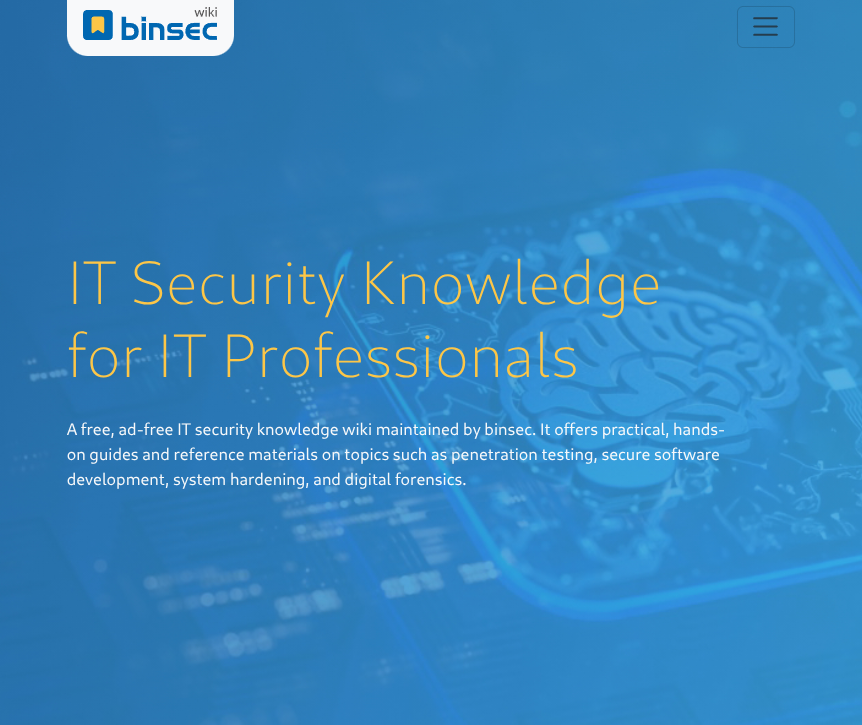
The goal of the relaunch was to make the platform more modern, faster, and even more user-friendly – without changing its core functionality: high-quality, practical content for security professionals and IT users. The new version is now live at https://binsec.wiki.
The new structure deliberately avoids visual gimmicks. Instead, the information architecture has been revised: clear typography, a logical page layout, and reduced graphic elements ensure optimal readability – even on mobile devices.
A central focus of binsec.wiki is on practical content for penetration testing. The articles not only convey theoretical knowledge, but also focus on typical testing scenarios, tools, audit trails, and detection patterns. The contributions are suitable as a training basis for red teaming, CTFs, security labs, or the internal development of technical security expertise.

Talk now
to our
Pentest experts.
Contact us

OSCP, M.Sc. Security Management
Talk now to our Pentest experts.
OSCP, M.Sc. Security Management
Manual Penetration Testing by Certified, In-House Senior Penetration Testers

Who tests
For more than ten years, binsec has stood for technically rigorous, strictly manual penetration testing. All engagements are conducted exclusively by employed senior penetration testers. Freelancers or subcontractors are not involved. Our clients work directly with the responsible senior tester who personally performs and technically leads the assessment. Communication is conducted in German and English; international projects are a regular part of our work. Our experts hold recognized offensive security certifications such as OSCP, OSCE, CRTO, and BACPP.
What we test
Our project experience covers complex enterprise networks, modern web and API architectures, and hybrid infrastructures. We work with organizations in manufacturing and industry, financial services and insurance, healthcare, IT and software providers, as well as public institutions. Technical, regulatory, and organizational requirements are systematically taken into account.
How we work
Our tests are based on a structured and reproducible methodology. They align with established standards such as OWASP and OSSTMM and are adapted to the specific project scope. Each assessment follows clearly defined phases: structured reconnaissance, manual analysis, targeted exploitation, and validated impact assessment. Automated tools support the process; identification, verification, and evaluation of vulnerabilities are performed manually.
Where we operate and document
Assessments are not conducted from cloud infrastructures. We operate our own infrastructure in a data center in Frankfurt. From there, all engagements are centrally executed and documented within our internal system PTDoc. PTDoc serves as the central documentation platform for all project data, evidence, and evaluations. All findings are recorded in a structured manner, technically described, risk-assessed, and supported by reproducible proof-of-concept information.
What you receive
We identify technical vulnerabilities and assess their business impact. Findings are evaluated based on risk or CVSS. The result is a clearly structured report including an executive management summary and detailed technical documentation. Re-testing of identified vulnerabilities is an integral part of our service.




 +49 692475607-0