Sept. 23, 2025
Internal penetration tests with PenPI
binsec GmbH performs internal penetration tests both on-site and remotely. For remote engagements, the team uses the PenPI (Pentesting Physical Interface) — a compact, preconfigured device securely integrated into the client’s network. This approach combines the accuracy of on-site testing with the efficiency and safety of remote execution.
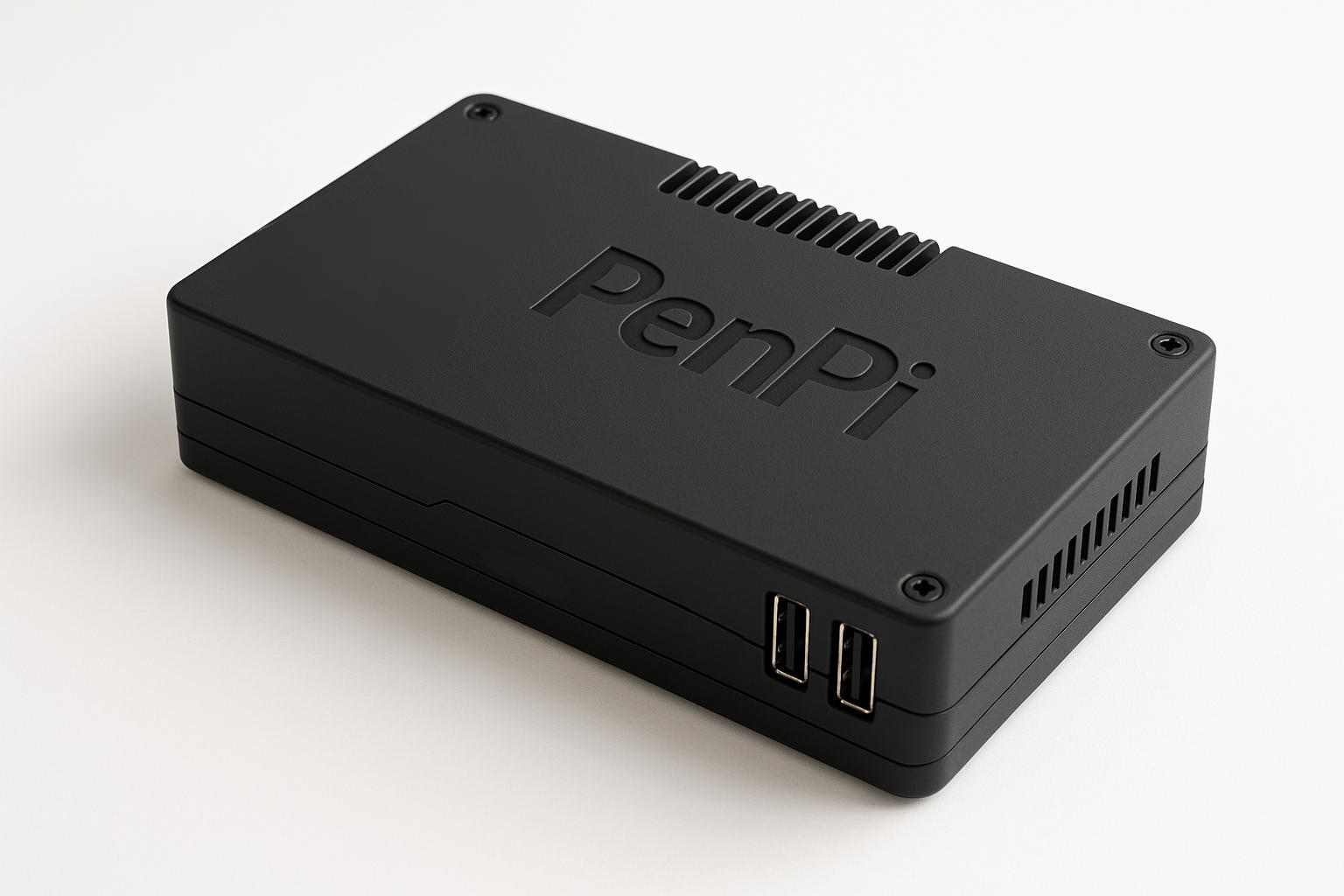
Benefits of PenPI-based remote testing:
- No travel or overnight accommodation costs — reduces expenses and logistics for both sides.
- No physical access by external contractors — avoids administrative hurdles and potential security or compliance concerns related to external personnel on sensitive premises.
- Familiar work environment for the testers — PenPI provides all standard tools and configurations, ensuring a standardized and reproducible testing environment.
- Capture network traffic outside business hours — traffic can be recorded, e.g., early in the morning or late at night, without testers being physically present.
- Secure connectivity — the PenPI establishes an encrypted VPN tunnel from the client’s internal network to binsec’s datacenter.
- Parallel deployment — multiple PenPI devices can be deployed across different network segments or locations to realistically reflect complex environments.
- Use for covert, longer-term operations — after initially authorized physical access, a PenPI can be used for persistent or covert testing as part of Red-Team engagements.
- Fast deployment and lower organizational effort — installation, execution, and reporting are efficient and transparent.

Talk now
to our
Pentest experts.
Contact us

OSCP, M.Sc. Security Management
Talk now to our Pentest experts.
OSCP, M.Sc. Security Management
Manual Penetration Testing by Certified, In-House Senior Penetration Testers

Who tests
For more than ten years, binsec has stood for technically rigorous, strictly manual penetration testing. All engagements are conducted exclusively by employed senior penetration testers. Freelancers or subcontractors are not involved. Our clients work directly with the responsible senior tester who personally performs and technically leads the assessment. Communication is conducted in German and English; international projects are a regular part of our work. Our experts hold recognized offensive security certifications such as OSCP, OSCE, CRTO, and BACPP.
What we test
Our project experience covers complex enterprise networks, modern web and API architectures, and hybrid infrastructures. We work with organizations in manufacturing and industry, financial services and insurance, healthcare, IT and software providers, as well as public institutions. Technical, regulatory, and organizational requirements are systematically taken into account.
How we work
Our tests are based on a structured and reproducible methodology. They align with established standards such as OWASP and OSSTMM and are adapted to the specific project scope. Each assessment follows clearly defined phases: structured reconnaissance, manual analysis, targeted exploitation, and validated impact assessment. Automated tools support the process; identification, verification, and evaluation of vulnerabilities are performed manually.
Where we operate and document
Assessments are not conducted from cloud infrastructures. We operate our own infrastructure in a data center in Frankfurt. From there, all engagements are centrally executed and documented within our internal system PTDoc. PTDoc serves as the central documentation platform for all project data, evidence, and evaluations. All findings are recorded in a structured manner, technically described, risk-assessed, and supported by reproducible proof-of-concept information.
What you receive
We identify technical vulnerabilities and assess their business impact. Findings are evaluated based on risk or CVSS. The result is a clearly structured report including an executive management summary and detailed technical documentation. Re-testing of identified vulnerabilities is an integral part of our service.




 +49 692475607-0