Overview and Practical Assessment from a Pentest Perspective
The Penetration Testing Execution Standard (PTES) describes a structured methodology for conducting penetration tests. The standard defines typical project phases ranging from preparation and technical analysis to the documentation of results. Although PTES is frequently referenced as a standard for the structure of a penetration test, in practice it is rarely the sole methodological foundation. The standard originally emerged around 2010 and has only seen limited development since then.
PTES deliberately describes the process of a penetration test on a conceptual level. The individual phases define the methodological framework, but provide only limited technical depth for specific testing. In addition, parts of the technical descriptions are now outdated. For example, Windows XP and Windows 7 are referenced as example systems for Windows-specific tools. In practical engagements, additional technical guides, project-specific methodologies and the experience of the penetration testers are therefore required.
The recognition of PTES within the industry is also influenced by the fact that the project website pentest-standard.org has achieved strong search engine rankings for many years. As a result, PTES is often perceived as a reference framework, even though many penetration testing teams rely more heavily on other technical guides and their own methodologies in practical engagements.
The testing methodology used by binsec incorporates all meaningful phases and aspects described in PTES. At the same time, our internal methodology is significantly more comprehensive. It is based on a testing approach developed over many years, taking into account modern IT architectures, current attack techniques, and practical project experience across a wide range of infrastructure and application environments.
PTES divides a penetration test into several consecutive project phases.
-
Pre-Engagement Interactions
At the beginning of a project, the objectives, scope and organizational framework of the engagement are defined. This includes the alignment of testing methodology, communication channels during the test, as well as potential limitations or particularly sensitive systems. The goal of this phase is a clear and well-defined testing scope. -
Intelligence Gathering
During this phase, structured information gathering about the target environment takes place. This may include publicly available information, technical metadata, domains, network ranges and technologies in use. These findings form the basis for the subsequent analysis. -
Threat Modeling
Based on the collected information, realistic attack scenarios are evaluated. Potential entry points, attack paths and particularly critical systems are identified. The objective is to focus the technical analysis on relevant attack scenarios. -
Vulnerability Analysis
In this phase, potential vulnerabilities are identified. Testing tools may be used to support the process. However, the actual analysis, verification and assessment of vulnerabilities is performed through structured manual testing. -
Exploitation
Identified vulnerabilities are exploited in a controlled manner to demonstrate their practical security impact. The goal is to provide a technically verifiable proof of the actual risk. -
Post-Exploitation
Following a successful compromise, the potential further impact is analyzed. This may include privilege escalation, lateral movement within a network, or access to sensitive data. -
Reporting
The results of the penetration test are documented in a structured report. The report describes identified vulnerabilities, their technical causes, their practical exploitability and their potential impact on the organization. Concrete remediation recommendations are also provided.
PTES therefore primarily defines the methodological framework for a penetration test. The actual quality of a test, however, depends on the technical depth of the analysis, the experience of the testers, and a structured manual assessment of the target systems.
Our service in a nutshell:
Conducting Penetration Testing (Pentest)
Since 2013 our certified penetration tester team conduct pentest for IT infrastructures, web applications, mobile APPs (iOS/Android) and other targets while every time using a structured approach based on all relevant publications. As a service provider evaluate the identified and exploited vulnerabilities based on the associated business risk and compiling it into a report that contains a summary for the IT management and the technical details of the vulnerabilities identified. After you fix the vulnerabilities, we usually perform a retest without any additional charge.
Contact usMore than 10 years of practical experience in penetration testing
No subcontractors or external freelancers
Direct communication with the responsible senior penetration tester
Structured, documented, and reproducible testing methodology based on PTDoc
Fully controlled in-house pentesting infrastructure, no cloud services used
Identification of technical and business-relevant security risks
Risk-weighted vulnerability assessment or CVSS based scoring
Report including executive summary and detailed technical section
Retesting of identified vulnerabilities included
Our service in a nutshell:
Conducting Penetration Testing (Pentest)
Since 2013 our certified penetration tester team conduct pentest for IT infrastructures, web applications, mobile APPs (iOS/Android) and other targets while every time using a structured approach based on all relevant publications. As a service provider evaluate the identified and exploited vulnerabilities based on the associated business risk and compiling it into a report that contains a summary for the IT management and the technical details of the vulnerabilities identified. After you fix the vulnerabilities, we usually perform a retest without any additional charge.
Contact usMore than 10 years of practical experience in penetration testing
No subcontractors or external freelancers
Direct communication with the responsible senior penetration tester
Structured, documented, and reproducible testing methodology based on PTDoc
Fully controlled in-house pentesting infrastructure, no cloud services used
Identification of technical and business-relevant security risks
Risk-weighted vulnerability assessment or CVSS based scoring
Report including executive summary and detailed technical section
Retesting of identified vulnerabilities included

PTES included Methodology
Pentest use the same tools and techniques that real attackers would use to break into a system. It includes the use of security tools and carrying out manual tests to uncover vulnerabilities. Thus is it not a automatic vulnerability assessment. On the contrary, as a service provider for penetration testing we are using the same tools and techniques that real attackers would use to break into a system. But while a real attacker only needs to find and exploit one vulnerability, a penetration tester checks all relevant attack vectors.
Having a structured approach is one of the most important factors to achive this in order to provide a professional pentesting service. Our approach is based on all relevant standards and publications and also includes the requirements of PTES.
Getting an Offer for a pentest
Pentest are always a compromise between effort and cost, to get a reasonable price. Successful pentest offer a good balance between these criteria to facilitate the testing of all relevant attacks and attack vectors. The cost of such a test always depends on the time the penetration tester spends and on the extent and complexity of the IT system or web applications. While a penetration test for a small application takes only some days, it can take several weeks for a large network or complex application.
For a pentest offers we do require prior information about the systems and applications that are to be examined. It is important that we get an initial impression of the target. For web applications, for example, test access can be helpful. Any additional information, e.g. the framework etc., can make it easier for us to draft a suitable offer for you. If you need us to pentest an IT system, we will need the corresponding network addresses in advance. In this particular case, we will first perform a non-invasive network scan to get a first look at your network. We will provide a detailed offer once we can estimate the effort required.
binsec GmbH is a german pentest company for professional penetration testing. Please get in touch with us if you would like to get a formal quote or if you have any questions. The company binsec GmbH is your pentesting vendor - get your pentest today!
Contact us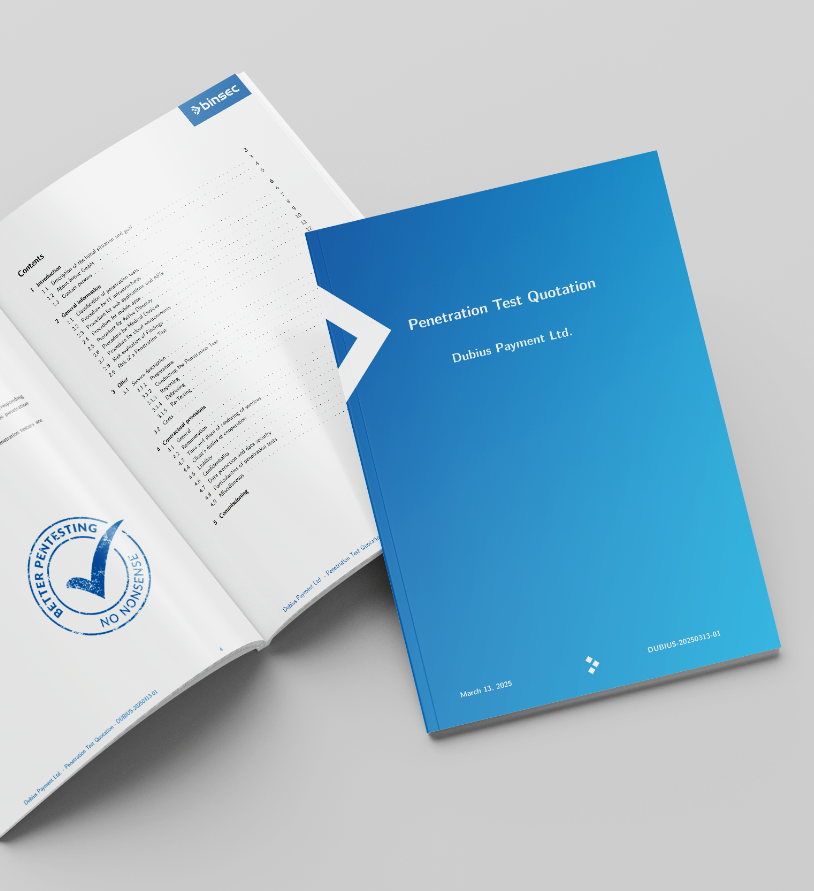
Pentesting
for specific standards and requirements
There are a lot of standards or legal requirements worldwide, that require conducting of a penetration test.
binsec GmbH for professional Penetration Testing PTES
binsec GmbH is the german professional penetration testing company that includes PTES in the pentest approach. Get a pentest offer without typical sales nonsense. Talk to experts instead to pre sales consultants. Better pentesting. No nonsense. As a professional penetration test provider we do some things differently than other pentest provider: As a penetration test firm, we do not sell vulnerability scans as pentest. We do also focus on business security risks. You are looking for a professionally conducted penetration tests? Get the binsec team for your PTES pentest!
Contact us
Frequently Asked Questions
It is difficult to give an generalized answer to this question, since the toolset used basically depends on the respective test object. Of course, we use tools such as nmap to check IT infrastructures or the Burp Suite Professional in the case of web applications.
However, we believe that publishing a tool list is mere window dressing, as each target system should be tested individually. However, you are welcome to ask us about the tools we used after the pentest.
Hosting critical business applications on a cloud provider such as Amazon AWS, Microsoft Azure, Google Cloud or Hetzner Cloud is becoming increasingly common.
Of course we perform penetration tests for applications hosted in the cloud. This also applies to penetration testing of cloud-based IT infrastructures, provided that the virtual machines are not managed directly by the cloud provider.
We perform penetration tests for almost any IT environment, system, application or network – right down to protocol fuzzing. Only the analysis of hardware chips under a microscope is something we leave to others.
Typical targets of our penetration tests include:
Web Applications and APIs
Mobile Applications
Servers, Platforms and Infrastructure
- Webserver Pentesting
- Network Pentesting
- Firewalls Pentesting
- WiFi / WLAN Pentesting
- Active Directory (AD) Pentesting
- RDP Server / Remote Desktop Pentesting
- OT Pentesting
Containers and DevOps
Identity and Authentication




 +49 692475607-0